How to help a child read at home, and why it's two jobs
Learning how to help your child read at home means doing two jobs: listening while your child reads aloud, and reading aloud to them long after they can read alone.

In this guide
Learning how to help your child read at home means doing two jobs: listening while your child reads aloud, and reading aloud to them long after they can read alone.
In many homes, the first job gets the attention in kindergarten and first grade, and the second fades once the child can get through a chapter book without help. A parent guide from the National Institute of Child Health and Human Development (NICHD) describes both jobs. Nemours KidsHealth says directly that a child's ability to read independently is no reason to stop reading aloud to them. A family can make room for both jobs in a routine that works for them.
What the 2024 national reading scores do and don't say
In 2024, 31% of U.S. fourth-graders performed at or above NAEP Proficient in reading, a national figure that does not describe any one child, school, or state.
NAEP, the National Assessment of Educational Progress, publishes its results as The Nation's Report Card. For the 2024 reading assessment, NCES tested a nationally representative sample of about 117,400 fourth-graders in 6,100 schools between January and March 2024, and released the results in January 2025. The 31% figure was down 2 percentage points from 2022 and 4 points from 2019.
The label is easy to misread. The report states that "the NAEP Proficient achievement level does not represent grade-level proficiency," and NAEP asks readers to interpret its achievement levels with caution. A fourth-grader reading on grade level under their state's standards may or may not reach NAEP Proficient, because the two are measured against different bars.
The national scores do not show how a particular family's home-reading routine affects an individual child. The scores help explain why reading keeps showing up in the news and in school newsletters. Reading-instruction requirements, including whether a third-grader can be held back for reading, vary by state; check your state's department of education for the rules where you live.

Reading at home is two jobs once kids can decode
Once a child can sound out words alone, the parent's role splits in two. You become the listener for your child's reading, and you stay the reader for books your child can't yet handle alone. Before that point, home reading can center on the parent reading while the child listens, looks, and talks.
NICHD's "Put Reading First: Helping Your Child Learn to Read" is an eight-page guide from 2001, written for parents of children from preschool through grade 3. The guide draws on the findings of the National Reading Panel. It asks parents to listen to their child read "words and books from school" and, separately, to "read together every day."
The two jobs practice different things, so one doesn't replace the other.
| Who reads | What it practices | What to watch for |
|---|---|---|
| Your child reads to you | Reading aloud and rereading familiar text | Long stalls, guessing from pictures, losing the thread |
| You read to your child | Listening to books above their independent reading level | Attention drifting, questions about words |
| You both talk about the book | Talking about what happened and why | Answers that only repeat the last page |
A child who reads well to you can still enjoy a book that is too hard to read alone. A child who struggles to read alone can still listen when you take a turn.
The first job is listening to your child read
Sit next to your child, let them do the work, and wait before you help. The NICHD guide puts it in one line: "Be patient and listen as your child practices."
Reading Rockets, a literacy site for parents and teachers, gives first-grade families a similar list. It suggests giving children lots of opportunities to read aloud, letting them reread favorite books, choosing books at a level they can manage, and taking turns reading aloud. Rereading can feel repetitive to adults. Rereading gives a new reader another chance to practice the same words.
For example, if a second-grader stops at "through" and stares at it, give a few seconds of quiet first. If nothing comes, say the word and let the child keep going, so the sentence doesn't fall apart. If the child is frequently stuck, try a more manageable book for this job, and move the harder one to the read-aloud pile.
The NICHD guide also suggests spending time "talking about stories, pictures, and words." One question after a page ("Why do you think she hid the key?") keeps the activity from feeling like a test.
If the same trouble spots show up night after night, write a few down and bring them to your child's teacher.
The second job is reading aloud to them
Keep reading aloud after first grade, because you can read books that are above your child's own reading level. Nemours KidsHealth's page on school-age readers notes that children start reading on their own at this age. The page adds: "But this doesn't mean that you should stop reading to your child."
According to KidsHealth, reading aloud to school-age children can build vocabulary, reading skills, and closeness. The page suggests looking for two types of books: ones your child could read alone, and ones above their current independent reading level that you read or help with. That second pile is the read-aloud job. It might be a chapter book with long sentences, a nonfiction book about a topic your child loves, or the next book in a series they aren't ready to read alone.
The American Academy of Pediatrics (AAP), in its 2024 policy statement on literacy promotion, recommends shared reading beginning at birth and continuing at least through kindergarten. That range ends at kindergarten, so the AAP statement on its own doesn't speak to reading aloud to a 9-year-old. For older children, the KidsHealth guidance is the more direct source.
Some older kids ask to be read to even though they can read. That request is easy to say yes to. A parent reading the harder book while the child follows along, or just listens, still counts as reading time.
A read-aloud can fit at bedtime or at another time that works for your family. Our guide to bedtimes by age shows where a reading slot can fit for each age.

If screens fill the hour before bed, our guide to screen time by age covers the AAP's guidelines for each age.

How to split the evening between the two
The sources reviewed for this guide found no national rule setting how many minutes a child should read at home or how to divide them. Start with whatever your child's school asks for on its reading log, and divide that time based on your child's reading stage.
If the log asks for 20 minutes, for example, a kindergartner might spend most of it listening to you and a few minutes reading a short, familiar book back to you. A fourth-grader might read part of a chapter to you, then hear you read a few pages of something harder. The table below is a starting point that families can adjust, not an agency standard.
| Grade band | Child reads aloud | Parent reads aloud | Talk about the book |
|---|---|---|---|
| K–1 | A short, familiar book, often reread | Most of the time | A question about pictures or words |
| 2–3 | A larger share, at a level they can manage | A chapter from a book above their level | What happened and what comes next |
| 4–5 | Part of a chapter, or a page from silent reading | A harder book, or one you take turns on | Why a character did something |
| 6 and up | Mostly silent reading of their own choice | If the child asks, or a shared book | A short conversation, not a quiz |
Ask the teacher what the log should record. Ask too whether it counts only the child's own reading or also time spent being read to. On a short evening, one job is enough. A tired child who listens to you read for ten minutes has still spent time with a book.
Reading logs usually sit next to other homework. Our guide to how much homework kids should have covers the guidelines schools commonly use.
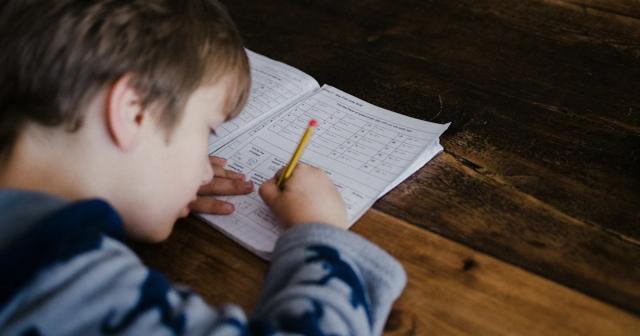
Which book, and who picks it?
Let the child pick the book they read to you, and share the choice of the book you read to them. Children may be more willing to open a book they chose themselves, and the read-aloud is where a parent can bring in something a little harder.
For the child's own reading, follow Reading Rockets' advice to choose books at a level the child can manage. For the read-aloud, the KidsHealth phrase "above your child's current independent reading level" is the guide. A child who wants the same book every night for the listening job is rereading, which the NICHD guide recommends.
A library card fills both piles without buying anything. Ask your local library about its rules for children's cards, and ask the children's librarian for books that match what your child already likes.
When a child resists reading, change the job before you drop the habit. A child who won't read to you that night may still listen to you read, and a child who won't sit for a story may read a comic or a recipe to you instead. Repeated arguments can make reading feel like a chore.
The National Education Association (NEA) describes Read Across America as a year-round program, with big celebrations on March 2 and throughout National Reading Month in March. As of November 2026, NEA has posted a calendar for 2026–27 with monthly themes, and a theme can be a simple way to pick the next read-aloud.
Tonight, ask your child for two books: one they want to read to you, and one they want you to read to them.
Frequently asked questions
Should I still read to my child if they can already read?
How can I help my child read on grade level?
How can I help my child read with dyslexia?
How can I improve my child's reading comprehension?
Sources
All sources checked on November 3, 2026.
- The Nation's Report Card: 2024 Reading at Grades 4 and 8 (NCES, January 2025) https://www.nationsreportcard.gov/reports/reading/2024/g4_8/
- "Put Reading First: Helping Your Child Learn to Read" publication page (NICHD, 2001) https://www.nichd.nih.gov/publications/product/240
- "Put Reading First: Helping Your Child Learn to Read" parent guide PDF (NICHD, 2001) https://www.nichd.nih.gov/sites/default/files/publications/pubs/documents/PRFbrochure.pdf#page=3
- "Reading Tips for Parents of First Graders" (Reading Rockets, undated) https://www.readingrockets.org/topics/activities/articles/reading-tips-parents-first-graders
- "School-Age Readers" (Nemours KidsHealth, May 2022) https://www.kidshealth.org/ChildrensAlabama/en/parents/reading-schoolage.html
- "Literacy Promotion: An Essential Component of Primary Care Pediatric Practice" (American Academy of Pediatrics, Pediatrics, December 2024) https://publications.aap.org/pediatrics/article-pdf/154/6/e2024069090/1750356/peds.2024-069090.pdf#page=1
- "Read Across America" frequently asked questions (National Education Association, January 28, 2021) https://www.nea.org/resource-library/read-across-america-frequently-asked-questions


