What to do with kids' artwork when one box sets the limit
Deciding what to do with kids' artwork means picking a limit, such as one acid-free box per child, and letting that box decide which pieces stay.

In this guide
Deciding what to do with kids' artwork means picking a limit, such as one acid-free box per child, and letting that box decide which pieces stay.
Through the school year, every drawing, painting, and worksheet your child wants to save goes into the box. When the year ends, keep what fits, photograph the rest, and then recycle it or give it away. Nobody has to judge a drawing at the kitchen counter on a Tuesday night, because the size of the box makes the call once a year.
What to keep comes down to one box per child
One workable rule is to keep only what fits in one box per child at each year's sort. The limit holds up better than judging piece by piece because the decision happens once, with the whole year in view, and the child can see the same rule you do.
Judging each drawing as it comes home tends to go one of two ways. Either almost everything gets saved because each piece looks fine on its own, or pieces disappear quietly and someone notices months later. A box gives parents and the child one shared rule: when the box is full, something has to come out to make room. Older keepers compete with new ones every year.
Pick a flat box wide enough that the largest sheets lie flat without folding. The Library of Congress lists acid- and lignin-free folders, mats, and document boxes as protective enclosures for works on paper, and notes that they are available in alkaline-buffered and neutral-pH forms. The same page cautions that some media can be sensitive to alkaline pH, so the box is one part of its storage guidance and the rest of the guidance still applies.
Not every piece is flat paper, and the box rule needs a version for each kind of work.
| Type of piece | Keep original | Photograph | Recycle or reuse |
|---|---|---|---|
| Crayon or marker drawing | If it fits in the box | Yes, before it leaves the house | Paper recycling, if your local program accepts it |
| Painting on paper | If it fits and is fully dry | Yes | Check your local program first |
| Pastel, charcoal, or pencil drawing | If it fits, in a paper folder instead of a clear plastic sleeve | Yes | Paper recycling, if accepted locally |
| Collage with glue or glitter | Rarely, since it takes room and can shed | Yes, plus one close-up | Check your local program; EPA gives no national rule |
| Clay, cardboard, or other 3D project | Only if it fits in the box | Yes | Reuse the parts, or follow local rules for each material |
| Worksheets and handwriting samples | If it fits in the box | Optional | Paper recycling, if accepted locally |
This guide is general information, not medical advice. If you have concerns about your child’s health or safety, consult a pediatrician or another qualified professional. Follow product labels and manufacturer instructions. In an emergency in the United States, call 911. Elsewhere, use your local emergency number.

What the Library of Congress says about storing paper
The Library of Congress advises keeping works on paper in a cool, relatively dry, clean, and stable place, with minimal light and no tape, glue, rubber bands, or clips. Its guidance is written for collections, so the "At home" column below is our adaptation for a house with kids.
The page puts rough numbers on "cool" and "dry": room temperature or below, and about 35% relative humidity. It also tells readers to avoid attics, basements, and spots at high risk of leaks or environmental extremes.
| Condition | Library of Congress guidance for paper | At home |
|---|---|---|
| Temperature | Room temperature or below | A closet inside the living space |
| Humidity | Relatively dry, about 35% relative humidity | Away from bathrooms and laundry rooms |
| Light | Minimal exposure to all light; no direct or intense light | A closed box, away from windows |
| Location | Avoid attics, basements, and leak-prone spots | A shelf off the floor on a main level |
| Enclosures | Acid- and lignin-free folders, mats, and document boxes | One document box per child |
| Fasteners and adhesives | No paper clips, fasteners, rubber bands, self-adhesive tape, or glue | Stack pieces loose and label them on the back |
Two details can trip up families with young artists. Clear polyester sleeves look tidy, but the Library notes that polyester film readily builds up an electrostatic charge that can lift powdery media such as pastel, charcoal, pencil, and flaking paint. A paper folder avoids that problem for those pieces.
Light is the other guideline most households break, since the fridge door and the hallway corkboard both sit in daylight. Rotating favorites through the display and then moving them into the box cuts the time they spend in the light.
The Library makes no promise about how long a drawing will last, and an acid-free box on its own does not settle the question. Its guidance also covers lignin, light, humidity, temperature, handling, and the materials the child used.
How to photograph flat art so it looks good on a screen
Lay the piece flat, hold the phone directly above it, crop to the paper's edges, and save the file under the child's first name and the date.
Google's instructions for its PhotoScan app, written for printed photos, say to place the photo on a flat surface with a contrasting background and hold the phone directly above it. The same setup is a reasonable starting point for a drawing: white paper on a dark table, or dark construction paper on a light one.
Google Drive's mobile app can scan a flat document, crop it, adjust the color, give it a file name, and save it as a PDF or JPG. On an iPhone or iPad, the Notes app scans a page automatically or manually and lets you drag the corners to fit the page before you tap Keep Scan. These help pages describe what the apps do; they say nothing about color accuracy or how long the files will last, so keep a second copy somewhere other than the phone.
A file name with the first name, grade, year, month, and one word about the piece still makes sense to a grown child 20 years from now.
Some families turn the year's photos into a printed book. Printed copies are physical objects again, so the Library of Congress guidance on photographs applies to them: a relatively dry, cool, and stable environment, at 70°F or below and 30% to 50% relative humidity, with limited light. The same page warns against albums with colored, "magnetic," or sticky self-adhesive pages. That page covers prints, not the digital files behind them.
Art from school often has a full name, a teacher's name, or a school name written across the bottom. HealthyChildren.org, the American Academy of Pediatrics' site for parents, lists a child's school name among the details to keep private. Its page on sharing kids' photos online says privacy settings can be worked around with screenshots and that a post you take down isn't necessarily gone. Cropping the label out before posting, or sending the photo straight to relatives, keeps those details off a public feed.
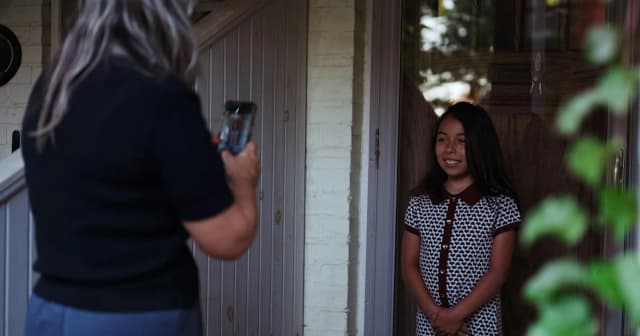
If you already take a first-day-of-school photo in the same spot each year, the art photos can follow the same habit, and that guide covers how to choose the spot.
Which pieces to recycle, and how to do it with the kid in the room
If you follow the box rule, recycle the pieces that don't make the box once they have been photographed, and decide ahead of time how involved the child will be. Families handle this differently, and each of the options below has a trade-off.
The first option is to let the child choose. Hand over the pile and the box, and let them pick what goes in until the lid won't close. Their picks may not match yours, and a quick sketch can beat the big painting a teacher praised.
The second option is to show the photo first. Take the pictures together, flip through them on the phone, and then put the paper in the bin. The child remains part of the decision and sees exactly where the picture went.
The third option is to sort while the child is at school or asleep. This is one choice among several, and it holds up better when the photo step still happens, so a piece can be found if the child asks for it later.
Before anything goes into the recycling bin, check what your program takes. As of October 2026, EPA's recycling page says most community programs accept paper and paper products, and it tells households to check what their own program accepts before putting paper in the bin. The page gives no national rule for paper covered in glitter, glue, or thick paint. Rules vary by municipality; check your local program's accepted-items list.
Pieces that miss the box don't have to go straight to recycling. Large paintings work as wrapping paper, smaller drawings fold into cards, and a grandparent may want a few. Mailing art to relatives moves the storage question to another house, so it helps to ask first.
Sort once a year when school lets out
Sort at the end of each school year, on or after your district's last day, and label every piece before it goes into the box. One fixed date gives the child a sorting day to expect.
Pew Research Center's analysis of more than 1,500 public school districts found substantial regional variation in start dates for the 2023–24 school year. Pew measured start dates, not end dates, so check your own district's calendar for the last day.
Label each piece on the back with the child's first name, grade, and the month and year. Write directly on the paper instead of adding a sticky label, since the Library of Congress advises against self-adhesive tape and glue on works on paper. A label on the back also keeps the front clean for the photo.
Empty the box, lay last year's keepers next to the new pile, and refill until the lid closes. Whatever is left gets photographed and named, then gets reused or recycled.
Families who kept a monthly photo series in a baby's first year will recognize the rhythm of a fixed date and a repeated routine, and that guide lays out a 12-month plan.

Before the box goes back on the shelf, look up the last day of school on your district's calendar and put the sort on the family calendar for that week.
Frequently asked questions
What should I do with kids' artwork from school?
How do I throw away my child's drawings without upsetting them?
What is a good way to store kids' crafts and drawings to look at later?
What do I do with kids' old artwork?
Sources
All sources checked on October 21, 2026.
- Library of Congress "Care, Handling, and Storage of Works on Paper" (Library of Congress, no date listed) https://www.loc.gov/preservation/care/paper.html
- Library of Congress "Care, Handling, and Storage of Photographs" (Library of Congress, no date listed) https://www.loc.gov/preservation/care/photo.html
- EPA "How Do I Recycle Common Recyclables" (U.S. Environmental Protection Agency, May 19, 2026) https://www.epa.gov/recycle/how-do-i-recycle-common-recyclables
- Google Drive Help "Scan documents with Google Drive" (Google, no date listed) https://support.google.com/drive/answer/3145835?hl=en
- Google Photos Help "Scan your photos" (Google, no date listed) https://support.google.com/photos/answer/7177983?hl=en
- Apple Support "How to scan documents on your iPhone or iPad" (Apple, February 13, 2026) https://support.apple.com/en-us/108963
- HealthyChildren.org "Sharenting: 5 Questions to Ask Before You Post" (American Academy of Pediatrics, November 20, 2019) https://www.healthychildren.org/English/family-life/Media/Pages/Sharenting-5-Questions-to-Ask-Before-You-Post.aspx
- HealthyChildren.org "Media Literacy Activities for Kids & Families" (American Academy of Pediatrics, January 6, 2026) https://www.healthychildren.org/English/family-life/Media/Pages/media-literacy-fun-skill-building-activities-for-children-and-families.aspx
- Pew Research Center "'Back to school' means anytime from late July to after Labor Day" (Pew Research Center, August 25, 2023) https://www.pewresearch.org/short-reads/2023/08/25/back-to-school-dates-u-s/


