A 15-minute family meeting agenda for kids under 10
15 minutes is the whole time budget in this family meeting agenda for kids under 10, with three short questions at its center.

In this guide
15 minutes is the whole time budget in this family meeting agenda for kids under 10, with three short questions at its center.
The questions are adapted from Bruce Feiler, who described his own family's weekly meeting in a Big Think video: what went well this week, what didn't, and what the family will work on next. In this agenda, add about three minutes on next week's shared calendar, end with something the kids look forward to, and meet at the same time every week. The agenda below is written for kids from kindergarten through fourth grade, with notes for families who also have a toddler at the table.
Why the agenda stops at 15 minutes
The 15-minute limit is a design choice for this agenda. It sits at the low end of the 15 to 20 minutes that Feiler says his family meets every Sunday night, and it is meant to end the meeting before the youngest child loses interest.
The sources checked for this guide don't set a fixed attention limit for children under 10, so treat the number as a timer setting you can adjust. Keep the meeting short enough to happen again next week. HealthyChildren.org, the American Academy of Pediatrics (AAP) site for parents, says that "Children do best when routines are regular, predictable and consistent." That page is about household routines in general, not family meetings, and as of October 2026 it lists a last update of June 28, 2024.
As a rule of thumb for this agenda, a meeting has run too long when the same problem comes up a second time, a parent starts explaining instead of asking, or the kids begin sliding off their seats. When the timer goes off, stop, even in the middle of a topic. Anything unfinished goes at the top of next week's notes, and the fun close still happens.
Short meetings are also easier to protect during a busy week. For some families, fifteen minutes after Sunday dinner may be easier to fit around sports, a late shift, or a visit from relatives than a 45-minute sit-down.
This guide is general information, not medical advice. If you have concerns about your child’s health or safety, consult a pediatrician or another qualified professional. Follow product labels and manufacturer instructions. In an emergency in the United States, call 911. Elsewhere, use your local emergency number.

The three questions, in order
Ask the three questions in this order: what went well this week, what didn't work, and what the family will try this week. Feiler's original wording is "what worked well in our family this week, what didn't work well, and what will we agree to work on in the week ahead," which he says was taken from agile development.
The youngest child who can answer goes first on every question. If an older sibling or a parent answers first, a younger child may simply echo that answer. Adults answer too, about their own week, so the kids see the whole family answering the same questions.
As a rule for this agenda, keep it to one answer per person per question. For the second question, ask everyone to describe a situation without blaming a person. "Mornings were too rushed" gives the family something to fix, while naming the sibling who was slow to find their shoes starts an argument. In a hypothetical example, a 7-year-old might say the hard part of the week was not knowing who was picking them up on Wednesday, which leads straight into the calendar check.
For this agenda, the third question ends with one agreement for the whole family. "Shoes go by the door the night before" is the right size. Write it down, and read it aloud at the start of next week's first question so everyone can say whether it worked.
Here is one suggested way to split the 15 minutes.
| Minutes | Item | Who speaks | What to write down |
|---|---|---|---|
| 0–1 | Start the timer, read last week's agreement | This week's leader | Nothing yet |
| 1–4 | What went well this week | Youngest first, then in age order | One good thing per person |
| 4–7 | What didn't work | Youngest first, then in age order | One problem per person |
| 7–9 | What to try this week | Whole family agrees | The one agreement |
| 9–12 | Next week's calendar | One adult reads, kids add | Changes, pickups, sitter days |
| 12–15 | Fun close | Leader picks | Next week's leader |
Add the calendar check before the fun part
In this agenda, allow about three minutes to walk through next week day by day, starting with anything that changes who picks up whom. One adult reads each day out loud, and the kids add what they know about their own schedule.
For this agenda, the main answer to give kids from the calendar is who will be there at pickup, and when. Say it plainly for each day, including the days a grandparent watches the kids, early-release days, practices, and any appointment that changes the usual routine. For example, telling a 6-year-old on Sunday that Grandma is picking up on Thursday may make Thursday afternoon less of a surprise.
Make changes on the calendar during the meeting, because changes saved for later are easy to forget. Kids who can't read yet can still point to their own color or sticker on a paper calendar. If grandparents or another caregiver cover some of those days, they need the same view of the week. A shared calendar they can open without installing an app keeps everyone working from one version.
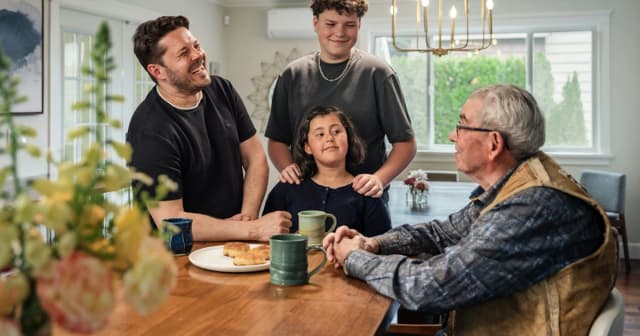
In this agenda, the last three minutes belong to the kids. The leader can pick a short card game, a dessert, or a song. Feiler says his family puts the allowance at the end "to make sure that they want to stick around," but this agenda uses a fun close instead, and whether to pay an allowance at all is a separate decision. The family could also look back at the week's photos and choose one or two to send to the grandparents, which ties back to what everyone just talked about.
If the grandparents aren't the type to open an app, a shared link, a digital frame, or a few prints in the mail can carry those photos to them.

Who leads, who writes, and what a 5-year-old can own
Rotate the leader every week, kids included, and keep an adult on notes until a child can write quickly. Feiler says that by four or five, kids in his family were ready to engage in the conversation, so this agenda proposes trying a first turn as leader around kindergarten age, with adult help.
This agenda uses three jobs. The leader starts the timer, reads the three questions, and calls on each person. The timekeeper watches the timer and says when it's time to move on. The note-taker writes down the one agreement, any calendar changes, and next week's leader.
A 5-year-old who is ready to join in may be able to lead if an adult writes the questions on an index card and reads along quietly. The same child can easily be timekeeper with a sand timer or a kitchen timer they are allowed to press. Some kids can write one word per answer; otherwise an adult takes notes, and a drawing works as notes too. Keep the notes in one notebook or on one sheet on the fridge, so next week's leader can find last week's agreement.
The rotation works the same in any household. In a single-parent home with, say, one adult and two kids, the adult simply takes every third turn. When a grandparent lives with the family, they can take a turn as leader like anyone else. Kids who spend part of the week in another home can hold the meeting in whichever home they're in on meeting night.
What to leave out of a meeting with young kids
Leave out disagreements between adults about money, any one child's discipline, and adult logistics that don't change the kids' week. Those belong in a separate conversation, usually after bedtime.
The test is whether a child at the table can do something with the information. For example, a young child may be able to help decide what to do on Saturday. The same child can't fix a disagreement between parents about a bill, and hearing it in a meeting tends to make the meeting feel tense the following week.
The age groups in this table are this guide's suggestion.
| Topic | Under 10 at the table | Ages 10 and up at the table | Adults only |
|---|---|---|---|
| Weekend plans, birthdays, visits | Yes | Yes | Yes |
| A chore that keeps getting skipped | Yes | Yes | Yes |
| Next week's pickups and sitter days | Yes, the short version | Yes | Yes, with all the details |
| One child's behavior or consequences | No | No | Yes |
| Disagreements about money | No | No | Yes |
| Adult work, legal, or medical details | Only what changes their week | Only what changes their week | Yes |
| Big family news, such as a move | After the adults have talked | After the adults have talked | Yes, first |
Kids sometimes bring up something heavy in the middle of the second question. Thank them, say it deserves more time than the meeting has, and name when you'll talk about it, such as "after the meeting" or "at bedtime tonight." Then follow through, so kids keep bringing things up the following week.
Does a family meeting still work with a toddler in the room?
Yes. Give the toddler a small, optional role. Feiler says that "maybe a two or three year old is not old enough," and the agenda doesn't need to change to fit them.
Give the toddler one small job that doesn't depend on talking, such as ringing a bell to start the meeting or holding the sand timer. You could let a toddler sit on an adult's lap with a quiet toy or crayons during the three questions. As an adaptation for this agenda, if they want a turn, let them say one thing during the first question, and move on without making them answer the other two.
Some families hold the meeting after the toddler's bedtime and invite them only for the fun close. That can help when a 2-year-old's evening routine is already tight. Since Feiler's family found kids ready to engage by four or five, that is one point to add a child to the first question, then to the others when they're ready.
For the first meeting, you can write the three questions on an index card and set it next to the timer on the table, so whoever leads has the agenda in front of them.
Frequently asked questions
What should a family meeting agenda template include?
What are good family meeting agenda topics for kids?
How is a family meeting agenda for adults different?
What does a 15-minute family meeting agenda example look like?
Sources
All sources checked on October 22, 2026.
- "Weekly Meetings for High-Functioning Families, with Bruce Feiler," video transcript (Big Think, date not listed) https://bigthink.com/videos/the-secrets-of-weekly-meetings-with-bruce-feiler-2/
- "The Importance of Family Routines" by Shelly Vaziri Flais, MD, FAAP (American Academy of Pediatrics, HealthyChildren.org, June 28, 2024) https://www.healthychildren.org/English/family-life/family-dynamics/Pages/The-Importance-of-Family-Routines.aspx
