What holiday traditions should we start with kids?
32 publications went into a 2002 Syracuse University review of family routines and rituals, which found those rituals were related to how well children adjusted.

In this guide
32 publications went into a 2002 Syracuse University review of family routines and rituals, which found those rituals were related to how well children adjusted.
For parents choosing holiday traditions to start with kids, the editors suggest something smaller than the usual list of 25 ideas: pick one to three traditions that cost little, and repeat each one on the same day, in the same way, every year. The review's authors named real limits in the studies they read. The repeat-every-year rule is an editorial suggestion built on how the review defines a ritual, so treat it as a starting point and adjust it to your household.
What 32 studies found about family rituals
Family routines and rituals were related to parenting competence, child adjustment, and marital satisfaction. The review did not show that rituals caused any of those outcomes.
The work came from Barbara H. Fiese and colleagues at Syracuse University and appeared in the Journal of Family Psychology in December 2002 (volume 16, issue 4, pages 381–390). The authors called it a qualitative review of 32 publications that appeared after a 1950 work on family rituals by J. Bossard and E. Boll, which they described as seminal. An American Psychological Association press release dated December 8, 2002, described the same body of research as 32 studies.
The authors were direct about the weak spots in the research they reviewed. The studies measured family routines in inconsistent ways, relied on samples of convenience (families who were easy to recruit), and did not separate direct effects from indirect ones. In practical terms, the review can say that rituals and child adjustment tend to show up together in the same families. It cannot say how much of that link comes from the ritual itself and how much comes from other things about the families who keep rituals.
A separate report from Emory University in 2005 adds some context from a different angle. It described a three-year study of 40 metro Atlanta families, each with a child between the ages of 9 and 12, who tape-recorded their dinnertime conversations. According to that report, children in families who regularly shared meals knew more about their family history and tended to have higher self-esteem. The project looked at dinners rather than holidays, and the source is an institutional news report about the study, so it says nothing direct about which holiday traditions a family should pick.
This guide is general information, not medical advice. If you have concerns about your child’s health or safety, consult a pediatrician or another qualified professional. Follow product labels and manufacturer instructions. In an emergency in the United States, call 911. Elsewhere, use your local emergency number.

A routine and a ritual are not the same thing
A routine covers what needs to be done, and a ritual says something about who the family is. The 2002 review drew that line on purpose, defining family routines as observable practices and family rituals as symbolic representations of collective events. Repeated, symbolic holiday traditions fall on the ritual side.
The APA press release put the difference in plainer words. Routines convey what needs to be done, while rituals "convey 'this is who we are' as a group and provide continuity in meaning across generations." Brushing teeth before bed is a routine. Reading the same winter book with a flashlight on the same evening every year is closer to a ritual, because the point of it is that the family does it together and remembers doing it before.
| What it is | Everyday example | Holiday example | What the 2002 review linked it to | |
|---|---|---|---|---|
| Routine | An observable practice; what needs to be done | Brushing teeth before bed | Packing the car before visiting relatives | Studied together with rituals; both were related to child adjustment, parenting competence, and marital satisfaction |
| Ritual | A symbolic representation of a shared event; who the family is | A Sunday dinner where the same story gets told | The same winter book read aloud on the same evening each year | Same association as routines; the review did not separate the two in that finding |
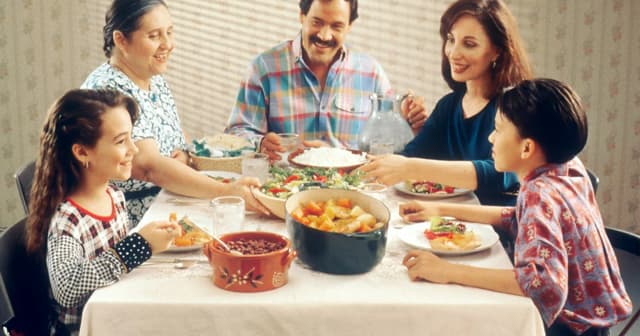
The rituals that came up most often in the reviewed research were ordinary ones, according to the APA release: birthdays, family reunions, Sunday dinners, and several religious and national holidays. What makes a winter tradition a ritual is that the family can describe it as something "we always do."
The wording a family uses is a quick test. "We eat dinner at 6" describes a routine. "On the first Saturday of December, we eat dinner on a blanket in the living room" describes a ritual, and a child will usually remember it as one.
Twelve low-cost traditions that fit any winter holiday
The twelve below range from a same-spot family photo and a shared family recipe to height marks on a door frame and a dated family drawing. None of them is tied to a particular holiday. The costs, times, and starting ages are editorial estimates as of November 2026, not a price survey or a developmental guide, and they will vary by location and by what a household already owns.
| Tradition | Rough cost per year | Time | Suggested starting age |
|---|---|---|---|
| Family photo in the same spot on the same date | $0 | 10 minutes | Any age |
| Bake one family recipe together | $5–$15 | 2 hours | 2 |
| Make one paper decoration and add it to a keepsake box | $0–$5 | 30 minutes | 2 |
| Read the same winter book aloud on the same evening | $0 with a library card, up to $15 | 20 minutes | 1 |
| Evening walk or drive to look at lights | $0 | 1 hour | Any age |
| Ask the same five year-end questions | $0 | 15 minutes | 3 |
| Write a one-page letter to each child | $0–$5 | 30 minutes | Any age (the parent writes) |
| Choose one toy or book to donate | $0 | 30 minutes | 3 |
| Living-room picnic dinner | $10–$20 | 1 hour | 1 |
| Deliver a small treat to neighbors | $5–$20 | 1 hour | 3 |
| Mark heights on a door frame or paper strip | $0 | 5 minutes | 1 |
| Everyone draws the family, and the drawing gets dated | $0 | 20 minutes | 2 |
Families who observe a specific holiday can attach any of these to it. Families who observe several holidays, or none, can tie the same tradition to winter break or to a fixed date in December. The table works either way because every row is about the family, not about a particular holiday.
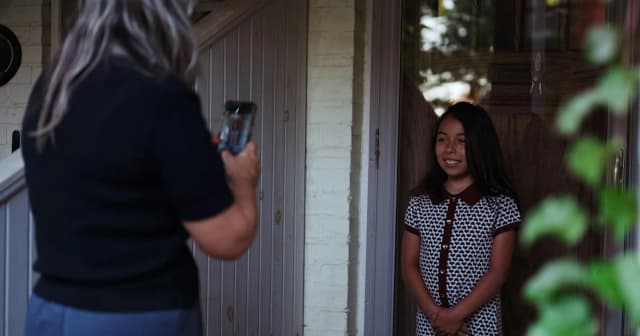
Several of the twelve leave a record by design. The photo, the decoration box, the height marks, and the dated drawing each produce something that can be laid next to last year's version. The same-spot photo follows the same logic as a first-day-of-school picture taken by the same door every year.
Matching outfits, paid events, and ticketed activities can be good fun, but they may cost more or be unavailable from one year to the next. They work better as occasional extras than as the tradition a family keeps.
Which tradition fits a toddler, and which can wait?
As an editorial rule of thumb, most traditions in the table can include a 2-year-old if the child's part is one short, hands-on step. The versions that need reading, writing, or a long stretch of sitting still can wait until a child is older, and the tradition itself can stay the same while the child's job in it grows.
Baking is one example, with ages that are illustrative only. At 2, a child might pour flour from a cup an adult has already measured. By 8, the same child might read the recipe card aloud, crack the eggs, and decide who gets the first cookie. The day, the recipe, and the kitchen stay fixed from year to year; the only thing that changes is how much of the work the child does.
Delivering treats to neighbors works the same way. A toddler can carry the bag to the door. A 5-year-old might help pick what goes in it, and an 8-year-old might write the note and decide which neighbors are on the list.
Traditions built around staying up late, sitting through a long show, or standing in crowds can wait. Those depend on a child's patience on a given night. For families with kids of mixed ages, the editors suggest a short shared version with an extra job for the older child instead of two separate traditions.
A short family meeting gives kids of different ages a turn in the same way. A companion guide lays out a 15-minute agenda with three questions for kids under 10.
The one rule that makes a tradition stick
Set four things in advance: the date, the steps, the person in charge, and a short record of what happened last year. This rule is an editorial suggestion. The 2002 review defined rituals and reported associations, and it did not test any method for keeping a tradition going.
Pick a date that does not move, and put it on the family calendar for this year and the next. A fixed anchor, such as the first Saturday of December or a set calendar date, stays put from year to year.
Write the steps on one index card: what happens, in what order, and what is needed. With the card in a known drawer, a grandparent, a co-parent, or a babysitter can run it the same way.
One adult takes responsibility for each tradition. That person puts it on the calendar, buys the flour or finds the book, and decides what happens if the date has to shift. In two-parent or multigenerational households, the editors suggest giving each adult separate traditions instead of sharing one.
Keep one small record of the tradition each year. One line in a notebook, one photo, or the object itself (the drawing, the decoration, the paper strip with the heights) is enough if it goes into the same place every year. The APA release described rituals as providing "continuity in meaning across generations," and a box of past years is a physical version of that continuity.
Monthly baby photos apply the same record-keeping idea to a single year. A companion guide sets out a 12-month plan.
How many traditions is too many?
As an editorial suggestion, one to three is a workable number for most households. Each tradition needs a fixed date, an owner, and a place for its record, and that work adds up quickly once there are more than a few.
Three checks help narrow the list. The tradition can happen on a date that will not move. One adult can run it alone if the other adults are busy that day. It costs little enough to repeat in a tight year. A tradition that passes all three has a good chance of being there next December.
Adding and dropping are both fine. The editors' rule of thumb is to add a second tradition only after the family has kept the first for two or three years. A tradition skipped two years in a row can be retired, and the family can say so out loud instead of letting it fade without a word.
The first step is small: choose one row from the table, pick its date, and write that date and the name of the adult who runs it on next month's calendar.
Frequently asked questions
What are good holiday traditions to start with toddlers?
How many family traditions should we have?
What is the difference between a family routine and a family ritual?
Do holiday traditions help kids?
Sources
All sources checked on November 2, 2026.
- Fiese et al., "A review of 50 years of research on naturally occurring family routines and rituals," Journal of Family Psychology 16(4):381–390 (PubMed abstract, December 2002) https://pubmed.ncbi.nlm.nih.gov/12561283/
- Press release on family routines and rituals (American Psychological Association, December 8, 2002) https://www.apa.org/news/press/releases/2002/12/rituals
- "Family meals important to children's emotional health" (Emory Report, Emory University, October 31, 2005) https://news.emory.edu/emory-report-archive/erarchive/2005/October/October%2031/S%26Rfamily.htm


