Is kids sharing a room easier with a zone each?
Kids sharing a room means two or more children sleep in one bedroom, and the setup runs smoother when each child has their own zone and a bedtime that matches their sleep needs.

In this guide
Kids sharing a room means two or more children sleep in one bedroom, and the setup runs smoother when each child has their own zone and a bedtime that matches their sleep needs.
A zone can be small. One possible setup gives each child one bed, one shelf, a reading light, and a rule that nobody touches the other child's things without asking. When the kids are far apart in age, stagger lights-out so the younger child is asleep before the older one comes in.
Our sources show no federal rule setting an age at which siblings in a private home must stop sharing a room. Parents may weigh privacy as puberty approaches and a wide age gap between the kids.
How common shared kids' rooms are in the US
The sources checked for this guide include no national figure for how many American children share a bedroom with a sibling. The closest public measure is a crowding indicator, and it counts people per room across the whole home.
A search-result summary describes a KIDS COUNT Data Center table from the Annie E. Casey Foundation called "Children living in crowded housing." According to that summary, it covers children ages 0 to 17 in households with more than one person per room. The summary attributes the data to PRB analysis of Census Bureau American Community Survey data. The table is reported to have been last updated in March 2025. The table page itself could not be opened for this guide, so no national percentage appears here.
The word "room" in that measure is broader than "bedroom." The Census Bureau's room-counting guidance for its housing questions counts "whole rooms used for living purposes, such as living rooms, dining rooms, kitchens, bedrooms." Bathrooms, kitchenettes, utility rooms, foyers, and halls are left out.
The difference shows up in families whose children share a bedroom. Take a family of four in a two-bedroom apartment with a separate kitchen and living room. Under the Census room-counting guidance, the apartment has four rooms, or one person per room. It would not count as crowded under a "more than one person per room" definition, even though the two children share a bedroom every night.
The Census wording comes from a help page about the housing questions, and it is not confirmed that KIDS COUNT applies that exact wording. Treat the apartment example as an illustration of how a per-room definition works. The crowding table describes tight housing overall, and plenty of families with a shared kids' room never show up in it.
This guide is general information, not medical advice. If you have concerns about your child’s health or safety, consult a pediatrician or another qualified professional. Follow product labels and manufacturer instructions. In an emergency in the United States, call 911. Elsewhere, use your local emergency number.

A setup for a toddler and a school-age child
One example setup for a 3-year-old and an 8-year-old uses two separate beds on opposite walls. The younger child gets low shelves, and the older child gets higher shelves and a small light they control on their own side. If a bunk bed is under consideration, federal rules require the bed's instructions to say: "Do not allow children under 6 years of age to use the upper bunk."
Start with the younger child's side, because that is where the AAP's advice for toddlers in a new bed applies. The AAP's HealthyChildren.org page "Big Kid Beds: When to Switch From a Crib," last updated in August 2022, says that while you wait for a new bed, you can "place the crib mattress on the floor." The same page says to clear away furniture and large toys "that could injure your child if they fell against them."
A shared room usually holds more furniture than a toddler's room alone. The 8-year-old's desk, bookcase, and dresser sit in the same space, and the AAP page tells parents to "take steps to prevent dressers and other furniture from tipping over." The CPSC's Anchor It! website says that "anchoring all furniture with drawers, doors, and shelves to the wall prevents tip-over injuries and deaths."
The AAP page also describes a safety gate across a toddler's bedroom door and a gate at the top of the stairs for a toddler who gets out of bed. In a shared room, a door gate has to let the older child in and out at bedtime as well, so think about where the older child's evening things live before the gate goes up.
Zones do most of the daily work. Give the 8-year-old the higher shelves and a lidded bin for anything they do not want a toddler to grab, and give the 3-year-old low, open shelves they can reach without climbing. A rug or a low bookcase that both kids can see marks where one side ends. Let each child pick one thing for their side, such as a poster or a bedspread, so the zone feels like theirs.
Light needs differ a lot at these two ages. In this example, the older child reads after the younger child is asleep. A clip-on reading light pointed at the older child's pillow, with the headboard between the light and the toddler, lets the older child read without lighting the whole room. A dim night light near the door can stay on for both.
A bunk bed saves floor space, but the instruction text above rules out the upper bunk for the 3-year-old. For the lower bunk, follow the manufacturer's instructions. As of November 2026, 16 CFR Part 1513 defines a bunk bed as "a bed in which the underside of any foundation is over 30 inches (760 mm) from the floor," and requires "at least two guardrails, at least one on each side of the bed." The part applies to bunk beds manufactured or imported on or after June 19, 2000.
These are requirements on bunk bed manufacturers. Follow the manufacturer's instructions that come with yours. Before using a secondhand bunk bed, the CPSC's recall search lets you filter by category, and Bunk Beds is one of the categories.
A setup for two school-age kids
For two school-age kids, one possible setup gives each child their own shelf and puts the homework spot where one child can work while the other sleeps or plays. Agree on a belongings rule before the room is set up. Kids this age can help draw the layout, so ask each one where their bed and shelf should go.
The shelf comes first because it is the one place each child controls. A bookcase split into two halves, or two matching cube units, works when the line between them is clear. Each child decides what goes on their shelf and how it looks. Shared things, like board games or art supplies, go in a bin that belongs to the room.
A shelf stays tidy longer when every type of item has one home, which is the idea behind this guide to organizing toys.
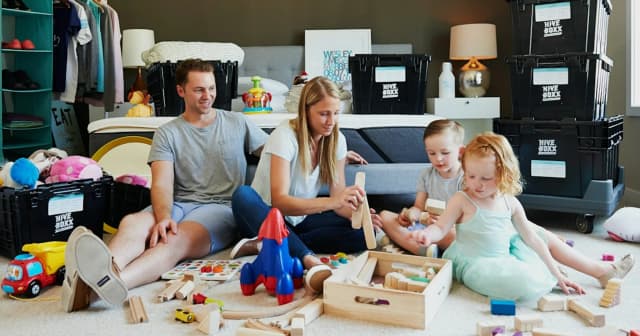
The homework spot is where two school-age kids collide most often. If one child has more homework, a desk in the bedroom keeps the overhead light on while the other child is trying to wind down. Moving homework to the kitchen or dining table keeps the bedroom for sleep and quiet play. If the desk has to stay in the room, give it a lamp that lights only the desk.
Keep the belongings rule short and easy for each child to repeat. For example: things on your shelf and your bed are yours, borrowing means asking first, and shared items go back in the shared bin. Write it down and post it at the kids' eye level. When a dispute comes up, point to the rule first.
If both kids are 6 or older, the instruction on children under 6 no longer rules out either bunk. The rest of the manufacturer's instructions still apply, and the anchoring advice from Anchor It! covers the bookcase that divides the room.
| Age pair | Beds | Each child's zone | Bedtime handling | Watch-outs |
|---|---|---|---|---|
| Toddler and school-age (for example, 3 and 8) | Two separate beds; the AAP page mentions a crib mattress on the floor while waiting for a new bed | Low open shelves for the toddler; high shelves and a lidded bin for the older child | Toddler down first; older child comes in later with a clip-on light | Bunk instructions must say no child under 6 on the upper bunk; CPSC Anchor It! on furniture |
| Two school-age kids (6 to 10) | Two beds or a bunk bed, following the maker's instructions | One shelf each; a shared bin for shared items | Example: same or close lights-out, with a reading light on each side | A homework spot that keeps the other child awake |
| Preteen and younger child | Two beds, with a divider if space allows | A curtain, bookcase, or screen for privacy | Older child comes in last | Privacy while changing clothes; a plan for when another room opens up |
Staggered bedtimes when sleep needs differ
Put the child who needs more sleep to bed first, in a dark and quiet room, and have the older child finish the whole bedtime routine somewhere else before coming in. The second child walks in ready for bed, turns on only their own light, and goes straight to bed.
How far apart the two bedtimes are depends on each child's sleep need, which changes with age. The order matters more than the exact gap. The child who falls asleep first should not be woken by a sibling getting changed, brushing teeth, or packing a backpack in the same room.
| Child | Lights out | Quiet-time rule | Source |
|---|---|---|---|
| Younger child (for example, 3) | First | Room is dark and quiet; the older child stays out until their own lights-out | Example family routine |
| Older child (for example, 8) | Second, after the younger child is asleep | Pajamas and teeth done in the bathroom; reading light on their own side only | Example family routine |
| Either child gets out of bed | Not applicable | Lead back calmly and quietly; praise for staying in bed | AAP "Big Kid Beds" page |
The hard moment is when the older child comes in. A toddler who half-wakes may want to talk or play. For a child who gets out of bed, the AAP page says to "calmly and quietly lead them back and tell them they must stay in bed," and that the aim is "to reward them with praise for staying in bed and not for getting out."
The older child can follow a similar script on the way in. No talking, straight to bed, and the reading light goes on only after they are under the covers. Practicing this routine once during the day, with the younger child pretending to sleep, turns it into a game the first few times.
Mornings need a plan too. The child who wakes first leaves the room quietly and has something to do outside it, such as a basket of books or a quiet toy by the couch. On weekends, the same rule keeps the late sleeper from being woken at dawn.
If you are still working out the right lights-out time for each child, see the guides to bedtimes by age and to how much sleep kids need.


When siblings stop sharing a room
Our sources show no federal age at which siblings in a private home have to stop sharing a bedroom. Parents may weigh privacy as a child approaches puberty, a wide age gap, and conflict that keeps one child from sleeping.
The same applies to a brother and a sister sharing. Our sources show no federal rule that bars a boy and a girl from sharing a bedroom in a family's own home. Foster care licensing and rental occupancy rules may apply in other settings. Rules vary by state; check your state's foster care licensing agency if you are a foster parent, and your local housing rules if you rent.
The signals usually come from the kids. A child starts asking to change clothes alone, or waits until the room is empty. One child's sleep gets cut short most nights. Homework or music practice needs a quiet room that the other child is using, or arguments about space happen every day.
The age gap is one thing to weigh. Two brothers who are 7 and 8 may have similar bedtimes and privacy needs. A 12-year-old and a 5-year-old are further apart in age, so watch for those signals earlier.
When no other room is available, privacy can be built into the shared one. A curtain on a ceiling track or a tall bookcase anchored to the wall can give a preteen a corner of their own. Changing in the bathroom and giving each child a set hour alone in the room cover much of the rest.
Before changing anything, talk with each child separately and ask what one change would make sharing easier. Write that change down for each of them and try both for a trial period you agree on.
Frequently asked questions
How do you divide a room for two kids?
When can you put two kids in the same room?
How many kids can be in one room?
How do I know when it's time for siblings to stop sharing a room?
Sources
All sources checked on November 5, 2026.
- "Big Kid Beds: When to Switch From a Crib" (HealthyChildren.org, American Academy of Pediatrics, updated August 1, 2022) https://www.healthychildren.org/English/healthy-living/sleep/Pages/Big-Kid-Beds-When-To-Make-the-Switch.aspx
- 16 CFR Part 1513, Requirements for Bunk Beds (eCFR, current as of November 1, 2026) https://www.ecfr.gov/current/title-16/chapter-II/subchapter-C/part-1513
- Search Recalls & Product Safety Warnings (U.S. Consumer Product Safety Commission) https://www.cpsc.gov/Recalls
- Anchor It! (U.S. Consumer Product Safety Commission) https://www.anchorit.gov/
- "Children living in crowded housing" (Annie E. Casey Foundation KIDS COUNT Data Center, updated March 2025 according to a search-result summary) https://datacenter.aecf.org/data/tables/67-children-living-in-crowded-housing
- "My living room and kitchen are in one big room" (U.S. Census Bureau help FAQ) https://www.census.gov/help/topics/faq.my-living-room-and-kitchen-are-in-one-big-room.html


