How to organize toys so kids put them away
Knowing how to organize toys for kids means giving every category one home that a 4-year-old can reach and recognize, then resetting those homes once a day.

In this guide
Knowing how to organize toys for kids means giving every category one home that a 4-year-old can reach and recognize, then resetting those homes once a day.
Sort by the age guidance on the packaging first, because CPSC tells parents to follow it. If a child under 3 lives in or visits the house, put toys with a small-parts warning on a shelf only adults reach. Then give each remaining category one open bin at kid height with a picture label. Once a day, the kids put everything back during a 10-minute reset before dinner, with an adult nearby.
Start with the age label
The age guidance on each toy's packaging determines where that toy belongs, so read it before taking out any containers. CPSC's consumer Toys page tells families to "follow age guidance and other safety information on toy packaging," and to keep small balls and toys with small parts away from children younger than 3.
One label is easier to find than the rest. As of October 2026, federal regulation 16 CFR 1500.19 requires a cautionary statement on covered toys and games intended for children at least 3 but under 6 when they include a small part. The official 2022 edition of the rule shows the wording, which opens with "WARNING: CHOKING HAZARD" and ends with "Not for children under 3 yrs." In a house with a baby or toddler, that line on the box is what sends a toy to the high shelf.
The other half of the rule sits with toy makers. According to CPSC's Toy Safety FAQ, products intended for children under 3 must not contain small parts or release them after use-and-abuse testing. A bead that escaped from an older sibling's craft kit and ended up in the block bin is a different matter. That is why the evening reset ends with a floor check.
CPSC also publishes Toy Safety Business Guidance, which says federal law made ASTM F963 a mandatory consumer product safety standard for children's toys. That page is written for manufacturers, importers, and other businesses, so parents can skip it. The consumer Toys page is the one written for households.
HealthyChildren.org, the American Academy of Pediatrics' site for parents, says warning labels tell you how to use a toy and which ages it is meant for. The same CPSC page also asks parents to choose toys that match each child's interests and abilities.
For the first sort, pull everything into one pile on the floor and check each box or tag. Toys with the small-parts warning go in one stack, toys labeled for an age older than your oldest child go in a second, and everything else goes in a third. If the packaging is long gone and the toy has pieces, you can choose to keep it in the high stack until you find the manufacturer's age guidance.
This guide is general information, not medical advice. If you have concerns about your child’s health or safety, consult a pediatrician or another qualified professional. Follow product labels and manufacturer instructions. In an emergency in the United States, call 911. Elsewhere, use your local emergency number.

One home per category at kid height
Give each category exactly one container in one fixed spot that your child can reach while standing on the floor. For this system, a category is any group your child can name in one word, such as cars, blocks, or dolls. If your child has no word for a group, fold it into one they do have a word for.
"One home" means the bin never moves. The cars live in the same bin, on the same shelf, in the same position every day, so a child returning a truck doesn't have to search for where the trucks went. With two bins for one category, a child holding a truck has to choose between them.
Kid height means the lowest shelf or the floor, with the opening facing out. Open bins suit the categories that get used daily, because one motion fills them. Lids fit puzzles and sets whose pieces need to stay together, and many of those end up on the high shelf after the first sort anyway.
The table shows how the three stacks from the first sort turn into homes. The categories are examples; use the groups your child already names.
| Category | Age label on the box | Who reaches it | Container type |
|---|---|---|---|
| Large blocks | No small-parts warning | Child, lowest shelf | Open bin |
| Cars and trucks | No small-parts warning | Child, lowest shelf | Open bin |
| Stuffed animals | Check the tag | Child, floor | Basket |
| Puzzles | Check each box | Child, if no small-parts warning | Flat bin with a lid |
| Building sets with small pieces | Small-parts warning | Adult, when a child under 3 is around | Lidded box, high shelf |
| Games and kits labeled for older kids | Age above your child's | Adult | Original box, high shelf |
Leave some headroom in every bin. A bin that overflows each night holds more toys than its home has room for, and no label will fix that. Cutting the number of toys is a separate job from organizing them.
When the pile on the floor is bigger than the shelves, decluttering comes first. The companion guide in this series covers decluttering toys before the holidays.
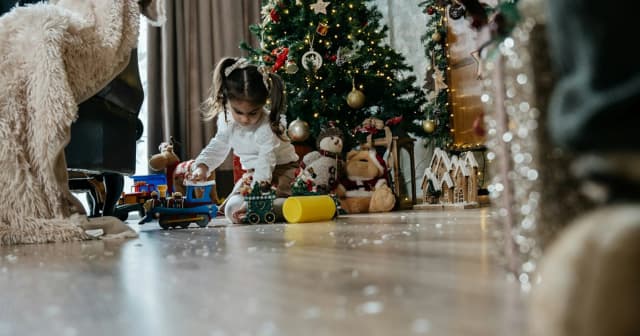
Picture labels a 4-year-old can read
Use a photo of the actual toys in each bin, printed and taped to the front, with the category word printed underneath. A child who can't read yet can still match a picture of their own red truck to the red truck in their hand.
Put a second copy of the same photo on the shelf edge where the bin sits. The bin label tells a child what goes inside, and the shelf label tells them where the bin goes back. That second label earns its place on the evenings a bin gets carried over to the couch. Matching the two pictures is a task a preschooler can finish without asking anyone.
Clip art of "animals" may show a cartoon lion while the bin holds farm animals and a plastic dinosaur, so a photo of the real toys is the closer match. Place labels at the child's eye level, which on a low shelf is closer to your knees than to your eyes.
If categories change often, attach the labels with hook-and-loop fastener dots so a photo can be swapped quickly. Packing tape works for labels that stay put. Letting your child take the photos may give them a reason to study the labels. The word under each photo is there for later, when your child starts to pick out letters.
What goes on the grown-ups-only shelf
Two groups go up high: toys whose packaging carries the small-parts warning, whenever a child under 3 lives in or visits the home, and toys labeled for an age older than the child who will use them. That follows CPSC's advice to keep small parts away from children younger than 3 and to follow the age guidance on toy packaging.
"Grown-ups only" is about who takes things down. A child old enough for the age on the box can still build with a small-piece set. An adult gets the box down, the play happens at a table, and the box goes back up when playtime ends. That keeps the shelf's rule short: only grown-ups reach up there.
Place the shelf above the reach of the youngest child in the house, or use a cabinet with a door. Visitors count as well. A house with no child under 3 may not need the shelf most days, and then a toddler cousin arrives for the weekend. The small-parts bins go up before the visit and come back down after it.
A high shelf is a way of following CPSC's advice, and it still depends on an adult returning the box every time. Supervision during play with small-piece sets stays the same as it would be without the shelf.
If the grown-ups-only shelf is the top of a bookcase, a child who wants what's up there may try to climb it. The furniture anchoring guide walks through strapping a unit to a wall stud.
The 10-minute reset before dinner
Once a day, before dinner, set a timer for 10 minutes. The kids put each category back in its home while an adult handles the grown-ups-only shelf and the floor.
Dinner makes a good anchor — it happens at roughly the same time each day and comes with a natural end, because when the table is ready, the timer is over. Families who eat at different times can tie the reset to bath time or the end of screen time instead. Use the same daily cue and the same cleanup order every time.
| Minute | Who | What goes back |
|---|---|---|
| 0–1 | Adult | Starts the timer and names the first category |
| 1–4 | Kids | Big items: stuffed animals, cars, and dolls |
| 4–7 | Kids | Blocks and every other category with a bin |
| 7–9 | Adult | Small-parts sets up to the grown-ups-only shelf; a floor check for loose small parts, in line with CPSC's under-3 advice |
| 9–10 | Kids and adult | Anything without a home goes in one "ask later" basket |
The adult's part of the reset is narrow. Calling out one category at a time ("cars next") may be easier for a young child than "clean up," which asks them to plan the whole room at once. The adult also puts the small-parts sets back on the high shelf and checks the floor for loose pieces. That follows CPSC's advice to keep small parts away from children younger than 3.
A car in the block bin counts as put away. Re-sorting after the kids are in bed adds work for the adult, and the kids never see where things were supposed to go. If the same toy lands in the wrong bin every night, the label or the category is the problem. Move the toy to the category your child keeps choosing, and change the photo to match.
The "ask later" basket catches toys that have no home yet. Empty it once a week, and give each toy in it a category or a place to go out of the house.
What if the living room is the playroom?
The same system can work in a living room with two changes: the homes go inside furniture that already belongs in the room, and fewer categories stay out at once. One home per category still applies, and so does the grown-ups-only shelf.
Baskets in a low cube unit or the lower compartments of a media cabinet can each serve as one category's home. Label them the same way, with a photo at your child's eye level. A rug or play mat marks where toys come out, which gives the reset a clear finish line: when the rug is clear, the room belongs to the adults again.
In a living room, the grown-ups-only shelf is usually a cabinet with a door or the top of a bookcase. The categories that aren't out can wait in a hall closet or on a high closet shelf, and swapping them on a schedule is toy rotation. The rotation guide in this series covers how to set up a swap schedule in an apartment.
Tonight, before dinner, pick the category your child plays with most, take one photo of it, and tape that photo to its bin.
Frequently asked questions
How do I organize toys for a toddler?
How do I organize toys in a small space?
What are fun ways to get a toddler to put toys away?
What should I do if my child won't put toys back after playing?
Sources
All sources checked on October 30, 2026.
- "Toys" consumer page (U.S. Consumer Product Safety Commission) https://www.cpsc.gov/id/Safety-Education/Toys
- "Toy Safety" FAQ (U.S. Consumer Product Safety Commission) https://www.cpsc.gov/FAQ/Toy-Safety
- "Toy Safety Business Guidance" for manufacturers, importers, and other businesses (U.S. Consumer Product Safety Commission) https://www.cpsc.gov/Business--Manufacturing/Business-Education/Toy-Safety
- 16 CFR 1500.19 (Electronic Code of Federal Regulations, up to date through October 27, 2026) https://www.ecfr.gov/current/title-16/chapter-II/subchapter-C/part-1500/section-1500.19
- 16 CFR 1500.19, official 2022 edition (Code of Federal Regulations via govinfo, January 1, 2022) https://www.govinfo.gov/content/pkg/CFR-2022-title16-vol2/pdf/CFR-2022-title16-vol2-sec1500-19.pdf#page=2
- "How to Buy Safe Toys" (HealthyChildren.org, American Academy of Pediatrics) https://www.healthychildren.org/English/safety-prevention/at-home/Pages/How-to-Buy-Safe-Toys.aspx


