How to make a family cookbook before the holidays
A family cookbook is a set of the recipes your relatives cook, written out clearly enough that someone else can make each dish from the page.

In this guide
A family cookbook is a set of the recipes your relatives cook, written out clearly enough that someone else can make each dish from the page.
How to make a family cookbook comes down to four steps. Collect the cards, test the recipes that have gaps, pick a format based on who will cook from it, and store the original cards in acid-free, lignin-free folders. Only the format depends on your family. It is also the step most likely to go wrong if you choose it first, so leave it until the recipes are in hand.
Collect the cards before you type anything
Gather every recipe in its original form, photograph each card with a phone, and note who wrote it and roughly when. Typing can wait until the pile stops growing.
Ask relatives by text or email for the dishes they would miss most, and ask for a photo of the card itself instead of a retyped version. If a gathering is coming up, ask people to bring their recipe boxes. Set aside a table where cards can be laid out away from the stove and the sink.
Lay each card flat on a plain surface near a window and hold the phone directly above it so the edges look square. Take a second photo of the back if anything is written there. Name each file with the dish, the writer, and the side, such as pound-cake_great-aunt_front. The same phone-versus-scanner choice comes up with old family photos, and our guide to digitizing them walks through it.
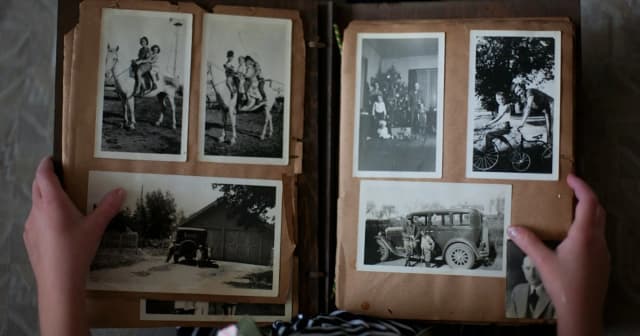
The National Archives recommends adding basic metadata to digitized family files: who, what, where, and when. For a recipe card, that means whose recipe it is, who wrote the card (sometimes a different person), where it came from, and an approximate year. A spreadsheet with one row per card is enough.
Some of that information exists only in someone's memory. A recipe often comes with a story about who brought it into the family or which holiday it belonged to, and a short recorded conversation keeps those details. The questions in our guide to interviewing grandparents work for recipe stories as well.
Leave the cards themselves alone while you work. The Library of Congress advises against paper clips, other fasteners, rubber bands, self-adhesive tape, and glue on paper, so sort cards into envelopes or folders instead of clipping them together. If a mark is necessary, the Library of Congress says to use pencil, not ink. The National Archives also says to keep originals after digitizing them, because digital files have their own risks and can easily be lost.

Test the recipes with missing steps
Cook the recipe once from the card, write down what you actually did on a separate typed copy, and leave the original untouched. A card that says "bake until done" becomes usable once someone records the pan size, the oven setting, and the time that worked.
Typical gaps are missing quantities ("flour to thicken") and units that no longer mean much ("a teacup of sugar" or "butter the size of an egg"). Some cards also leave out steps or give no pan size at all. Read the card aloud before cooking and list each gap on the typed copy.
If the person who wrote the recipe still cooks it, the fastest test is to cook it with them and measure what goes into the bowl. One person cooks and another writes. Otherwise, make it once with notes in hand and adjust on a second try if the first result is off.
Keep both versions on the typed page. Print the original wording first, exactly as written, then the tested version with measured amounts and numbered steps, and finish with a line saying who tested it and when. Anyone reading the book later can see what the card said and what your family did with it. If a card involves home canning or preserving, keep its wording in the book as a record and leave that method out of the testing.
Pick a format based on who will cook from it
Choose the format for the person most likely to cook from the book. A binder suits someone who cooks every week and wants to add pages. A shared digital folder suits relatives in different states, and a printed book works well as a gift meant mainly for reading.
| Format | Who it suits | Cost | Add recipes later | Originals stay separate |
|---|---|---|---|---|
| Three-ring binder with sheet protectors | A regular cook who wants pages that wipe clean and stay open | A binder, protectors, and home printing | Yes, one page at a time | Yes, if you file copies, not cards |
| Shared digital folder | Relatives spread out, teens who cook from a phone | Varies by storage service | Yes, anyone with access | Yes |
| Printed photo book | Gifts for several households | Photo books from $12 to $24.98 to start, as of October 2026 (see below) | No, a change means a new order | Yes |
The formats can overlap. A binder for the kitchen and a printed book for gifts can come from the same typed files, and the digital folder is where those files live anyway.
For a printed book, three photo book services publish starting prices; Blurb and Mixbook also publish page ranges. The figures below are starting prices from each company's own pages. Shutterfly says its figures exclude promotions, upgrades, shipping, and taxes, and the checkout price at any of the three services may differ.
| Service | Starting price | Pages | Binding notes |
|---|---|---|---|
| Shutterfly photo books | $24.98 softcover, $39.98 glossy hardcover (20 pages, 8×8, Aug 2026 guide) | Price quoted for 20 pages | Softcover and hardcover listed |
| Blurb Photo Books | From $12 in six sizes (Oct 29, 2026) | 20 to 440, depending on paper | Softcover, ImageWrap hardcover, linen hardcover, layflat; no spiral or coil |
| Mixbook photo books | Softcover $14.99, hardcover $29.99, layflat $74.99 (Oct 29, 2026) | 20 to 400; layflat 20 to 100 | Softcover, hardcover, layflat |
Blurb also lists text-and-image Paperback & Hardcover Books from $3.99, as of October 29, 2026. A book that stays open on the counter is easier to cook from, and Blurb says its Photo Books do not offer wire-o, spiral, or coil binding. Blurb and Mixbook both list layflat options. Weigh binding, page count, and price against how the book will be used, and check each service's current page before ordering.
Store the original cards the way archivists do
Keep the originals in acid-free, lignin-free folders or boxes in a cool, dry spot inside the main living space, away from attics, basements, garages, and leaky pipes. The National Archives and the Library of Congress both publish storage guidance, with different numbers.
The National Archives page on storing family papers, last reviewed September 18, 2025, recommends containers made of board or folder stock that is lignin-free and acid-free or buffered. It says to keep the temperature below 75°F and relative humidity below 65%, and to avoid relative humidity below 15% because it can cause brittleness. It also says to keep items out of damp basements, garages, and hot attics, and away from pipes, windows, and known roof leaks.
The Library of Congress sets a stricter target for works on paper: a clean, stable room at room temperature or below, at about 35% relative humidity, away from attics and basements. The National Archives figures work as upper limits for a home, while the Library of Congress figure is closer to an ideal.
The National Archives lists rubber bands, pressure-sensitive tape, self-stick "magnetic albums," non-stainless clips and staples, and PVC or unknown plastics among the things to avoid with family papers. That rules out the old recipe box with a rubber band around each section, and a plastic sleeve of unknown material is a poor home for an original card.
Group the cards by family branch or by the person who wrote them, and write labels in pencil on the folders instead of on the cards. Put a printout of the provenance spreadsheet in the box. If the project turns up letters or photos you want to set aside for years, the same storage questions apply, and our time capsule guide covers what holds up over a decade.
A timeline that finishes before the holidays
The schedule below spreads the work over four weekends starting Saturday, October 31, and ends a few days before Thanksgiving on November 26, 2026. It is a suggested plan, not a measured time, so a large collection may need more weekends. A printed book gets two more weekends in the plan.
| Weekend | Task | Done when |
|---|---|---|
| Oct 31–Nov 1 | Ask relatives for recipes; photograph the cards you already have | Every known card has a photo and a spreadsheet row |
| Nov 7–8 | Photograph late arrivals; choose the recipes; type drafts and list gaps | Each chosen recipe has a typed draft |
| Nov 14–15 | Cook the recipes with gaps and record the tested amounts | Every gap is filled or marked unknown |
| Nov 21–22 | Pick the format; assemble the binder or folder; file the originals | Cards are in folders, files are backed up |
| Nov 28–29 and Dec 5–6 | For a printed book, lay out pages, proofread, and order | Order placed and delivery estimate checked |
Test only the cards with gaps. A recipe with full amounts and clear steps can be typed as written, which keeps the third weekend manageable. Blurb and Mixbook list 20 pages as their minimum, and Shutterfly quotes its starting prices for 20 pages. A first edition from Blurb or Mixbook needs enough recipes, card photos, and stories to fill at least 20 pages.
The fourth weekend is also when the files need a backup. The National Archives recommends the 3-2-1 rule for digitized family files: three copies, on two different kinds of media, with one copy kept off-site. For a cookbook, that could be the shared folder, an external drive at home, and a copy at a relative's house.
Send each relative a text asking for a photo of the one recipe card they would least want to lose, and the collection starts with whatever comes back by Sunday.
Frequently asked questions
How can I make a family cookbook for free?
How do I get a family cookbook printed?
What should I do with a late grandparent's recipe collection?
How do I make a family cookbook that lasts as an heirloom?
Sources
All sources checked on October 29, 2026.
- "Storing Family Papers and Photographs" (National Archives, last reviewed September 18, 2025) https://www.archives.gov/preservation/family-archives/storing
- "Digitizing Family Papers and Photographs" (National Archives, May 26, 2021) https://www.archives.gov/preservation/family-archives/digitizing
- "Care, Handling, and Storage of Works on Paper" (Library of Congress, undated) https://www.loc.gov/preservation/care/paper.html
- "How Much Do Photo Books Cost?" pricing guide (Shutterfly, August 25, 2026) https://www.shutterfly.com/ideas/how-much-do-photo-books-cost-pricing-guide/
- "Shop All Products" format FAQ (Blurb, 2026) https://secure.blurb.com/formats
- "Compare products & pricing" (Blurb, October 29, 2026) https://photos.blurb.com/pricing
- "Everyday Photo Book" product comparison (Mixbook, October 29, 2026) https://www.mixbook.com/all-photo-books/everyday-photo-book-9592
- 2026 federal holiday schedule (U.S. Office of Personnel Management, 2026) https://www.opm.gov/policy-data-oversight/pay-leave/federal-holidays/


