Toy rotation rests on one study of 36 toddlers, 4 vs 16
36 toddlers, 4 toys versus 16: that comparison, from a 2017 University of Toledo study, is the starting point for this toy rotation guide.

In this guide
36 toddlers, 4 toys versus 16: that comparison, from a 2017 University of Toledo study, is the starting point for this toy rotation guide.
In a supervised playroom, the children played longer and in more ways when only 4 toys were available. The study did not test how many toys a home should have out or how often to swap them. For a small apartment, a workable start is 6 to 10 toys out, the rest split between two labeled bins, and a swap on the first of each month. Those numbers are an editorial starting point; no study produced them.
What the Toledo study measured
The researchers recorded three things about play: how often each toddler started playing with a toy, how long that play lasted, and how many different ways the toys were used. Each child played alone under two conditions, once with 4 toys in the room and once with 16.
The paper is Dauch et al., "The influence of the number of toys in the environment on toddlers' play," published online on November 27, 2017, in Infant Behavior and Development. As of October 2026, its PubMed abstract describes 36 participants in "supervised, individual free play sessions" in the Four Toy and Sixteen Toy conditions. The University of Toledo's news release from December 18, 2017, adds that the children were 18 to 30 months old and that each child visited the playroom laboratory twice.
With 4 toys, the abstract reports, the toddlers had "fewer incidences of toy play, longer durations of toy play," and played with the toys in a greater variety of ways. Fewer incidences means fewer separate bouts of play.
The news release used stronger wording than the paper. It said the toddlers "played twice as long with the toys they had" in the smaller set. The abstract reports longer durations without giving that multiplier, so "twice as long" is the university's own summary of the result.
Alexia Metz, one of the study's investigators, offered a practical suggestion in the same release: "Save some for later and swap them out." That line is the closest the Toledo work comes to describing toy rotation. It is a researcher's comment, and the experiment itself did not test any swap schedule.
This guide is general information, not medical advice. If you have concerns about your child’s health or safety, consult a pediatrician or another qualified professional. Follow product labels and manufacturer instructions. In an emergency in the United States, call 911. Elsewhere, use your local emergency number.

What the study can't tell you
It can tell you that, in one lab setting, 36 toddlers played differently with 4 toys than with 16. It cannot tell you the best number of toys for your home, how often to rotate, or whether the effect carries over outside the playroom.
| Item | In the study | At home |
|---|---|---|
| Children | 36 toddlers, ages 18 to 30 months | Any age, often siblings of different ages |
| Place | A university playroom laboratory | A living room, bedroom, or shared corner |
| Toy counts | 4 or 16 | Whatever the household owns |
| Supervision | Supervised, one child at a time | Mixed, with siblings and chores going on |
| Visits | Two | Every day, for months |
| What was recorded | Play bouts, duration, and variety of play | Nothing is being measured |
A group of 36 children is small, and every one of them was between 18 and 30 months old. The result says nothing direct about babies, preschoolers, or school-age kids. The sessions also took place in a lab and were supervised.
Time is another gap. The abstract describes play within the sessions and reports no follow-up over weeks or months.
The study compared only two numbers, 4 and 16. Because the abstract reports only those two conditions, it does not appear to establish whether 4 is better than 6, 8, or 10, or that 4 is the right number for every child. Reading "4 toys" as a prescription takes the result further than the design allows.
The American Academy of Pediatrics' 2018 clinical report "The Power of Play" makes a broader point. It describes developmentally appropriate play with parents and peers as "a singular opportunity" to promote social-emotional, cognitive, language, and self-regulation skills. The report is about play itself and does not address toy rotation or a toy count.
How many toys out at once?
Start with 6 to 10 toys out, and adjust after two weeks of watching. That range is an editorial starting point between the study's two conditions, and the two-week check is editorial too; no research has identified either as an optimum.
In our editorial view, the reason to go above 4 is that a home has more than one kind of play in a day. A toddler may want something to push, something to stack, a book, and a doll in the same afternoon, and a sibling may share the floor. Staying well below 16 follows the direction of the Toledo result, though the study did not test homes. It also reflects how quickly floor space disappears in an apartment.
For this guide's count, each play type is one toy: a set of stacking cups counts as one, and so does a basket of blocks. One illustrative 8-toy set for an 18-month-old might be blocks, a shape sorter, a push toy, a large ball, two board books, a stuffed animal, and a drum. Before anything goes into the out set, check the packaging. CPSC tells families to "follow age guidance and other safety information on toy packaging" and to keep small balls and toys with small parts away from children younger than 3.
This guide suggests watching for two signals over the first two weeks. If the same few toys get used and the rest sit untouched, put two of the untouched ones away. If the child wanders and asks for things from the bins every day, add one or two back.
A rotation may be easier to keep up when each toy in the out set has a fixed spot where a child can find it and put it back. The guide to giving every toy category one home covers that setup.
A two-bin rotation for a small apartment
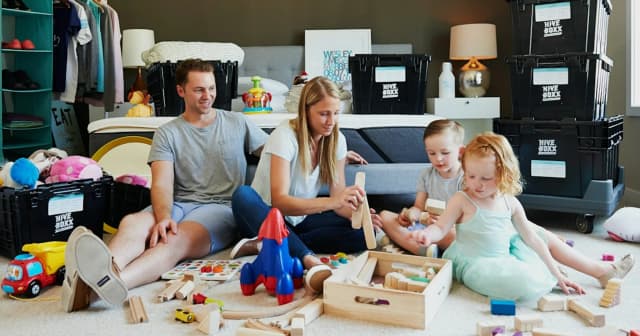
Split the toys into three groups with a similar mix of play types. One group is the out set on a low shelf or in one open basket, and the other two go into two lidded bins kept out of the child's sight and reach. This layout is an editorial suggestion; the Toledo study did not test bins or groups.
In an apartment, the bins usually end up on a closet shelf, under a bed, or on top of a wardrobe. Measure the space before buying bins. Opaque bins keep the contents out of view. Label each bin with its group number, and tape a photo of the contents to the lid so nobody has to open both bins to find the train set.
Toys with small parts that belong to an older sibling need their own place. CPSC's advice to keep small parts away from children younger than 3 applies to stored toys too, and a bin that a toddler can reach and open may not keep those parts away. The childproofing checklist for 6 months, 1 year, and 3 years covers what toddlers in this age range can reach.
Swap on the first of the month, favorites stay
On the 1st of each month, the group in the out set goes into the empty bin and the next group comes out. Comfort objects stay out every month, and so do any toys a child uses as part of therapy.
The first-of-the-month date and the exceptions for favorites are editorial choices. The Toledo study did not test a schedule, and Metz's comment in the release was only to save some toys for later and swap them out. A fixed date means nobody has to decide when the swap is due. Every two weeks is another editorial option if the child quickly loses interest in the toys that are out.
| Date | Bin out | Bin in | Stays out |
|---|---|---|---|
| Nov 1, 2026 | Group 2 | Group 1 | Comfort object, therapy items |
| Dec 1, 2026 | Group 3 | Group 2 | Comfort object, therapy items |
| Jan 1, 2027 | Group 1 | Group 3 | Comfort object, therapy items, gifts in use |
| Feb 1, 2027 | Group 2 | Group 1 | Comfort object, therapy items |
In this example schedule, with three groups, each set of toys comes back every three months.
A lovey, a blanket, or a stuffed animal a child sleeps with stays outside the system. The same goes for one current favorite that the child asks for daily; it can skip a swap and go into a bin next month. For a child who uses specific toys as part of therapy, talk to the child's therapist or pediatrician before putting any of them into a bin.
The December and January swaps fall around the holidays, when new gifts may arrive and raise the total count. Clearing out toys before then keeps the three groups from growing past what the bins hold, and the three-weekend decluttering plan lays out that work.

When toy rotation isn't worth it
Toy rotation adds little when a household owns only about as many toys as an out set would hold. It also adds little when kids are old enough to work on long-term projects, or when there is nowhere to put the bins.
With about 10 toys in total, the top of this guide's suggested out set, there is nothing left to store, and the whole collection already fits on one shelf. Older children are a different case. The Toledo study covered 18 to 30 months only, and a 7-year-old building a block city over several weeks may need every piece available, not a third of them.
Shared rooms need a rule before the first swap. If a toddler and a 5-year-old share the space, one option is to keep the older child's toys on a separate shelf outside the rotation, so a toy does not disappear into a bin on someone else's schedule. If the only place for the bins is the same room, in plain view, a one-time cleanout may do more than a rotation.
If rotation does fit your home, start by setting the comfort object aside, then sort what is left on the floor into three piles.
Frequently asked questions
How many toys should a toddler have out at one time?
How often should I rotate my baby's toys?
Is there such a thing as too many toys?
What is a toy rotation system?
Sources
All sources checked on October 30, 2026.
- "The influence of the number of toys in the environment on toddlers' play," Dauch et al., Infant Behavior and Development, abstract (PubMed, National Library of Medicine, November 27, 2017) https://pubmed.ncbi.nlm.nih.gov/29190457/
- "Fewer toys lead to richer play experiences, UT researchers find" (University of Toledo, December 18, 2017) https://news.utoledo.edu/index.php/12_18_2017/fewer-toys-lead-to-richer-play-experiences-ut-researchers-find
- "The Power of Play: A Pediatric Role in Enhancing Development in Young Children," AAP clinical report, Pediatrics, abstract (PubMed, National Library of Medicine, August 20, 2018) https://pubmed.ncbi.nlm.nih.gov/30126932/
- "Toys" consumer safety page (U.S. Consumer Product Safety Commission, undated) https://www.cpsc.gov/id/Safety-Education/Toys


