Which birthday interview questions might work from age 3?
A workable plan for birthday interview questions for kids: the same ten, asked in the same words each birthday from about age 3, kept on one card and a two-minute video.

In this guide
A workable plan for birthday interview questions for kids: the same ten, asked in the same words each birthday from about age 3, kept on one card and a two-minute video.
The repetition does the work. A favorite food at 3 means little by itself, but set next to the answers at 7 and 12, it starts to read like a record of one person changing. Fixed wording is meant to keep that comparison consistent. Ten questions, age 3, and two minutes are this guide's suggestions with no study behind them, so adjust them once at the start and then leave them alone.
Why the same ten questions every year
This guide keeps the wording fixed so the answers are easier to compare. If "What do you like to do most?" turns into "What's your hobby?" at age 9, a new answer could come from the child or from the new question, and years later it may be hard to tell which. That reasoning is an editorial one; none of the research cited here tested it.
Ten is a workable number, and like the starting age it is an editorial choice.
The order stays fixed too. Keep the questions on one master card and read them top to bottom each time, so question six is always question six. If you think of a better question later, add it as number eleven at the end. The original ten stay as written, including the ones that feel young for a 12-year-old, because dropping a question makes that particular run of answers less consistent.
Birthdays already repeat on their own. A 2002 American Psychological Association press release on a review of family rituals research listed birthdays among the family rituals identified most often in that literature. A birthday interview adds a small, fixed record to a day that comes back every year anyway.
The same review is the starting point of a separate guide to holiday traditions with kids.


The ten questions, worded for a 3-year-old
The ten questions are listed in the table below, worded once for age 3 and kept word for word the same at 10 and 15. Older kids can get one optional follow-up, asked only after the core answer is written down, so the core question never changes.
| Topic | Wording at age 3 (and every year after) | At 10, same question plus | At 15, same question plus |
|---|---|---|---|
| Age | "How old are you today?" | Nothing | Nothing |
| Food | "What food do you like best?" | "Who makes it best?" | "Can you make it yourself?" |
| Play | "What do you like to do most?" | "Who do you do it with?" | "When do you get time for it?" |
| Friends | "Who do you like to play with?" | "What do you do together?" | "How did you meet?" |
| Laughing | "What makes you laugh?" | "When did you last laugh hard?" | Same as at 10 |
| Dislikes | "What don't you like?" | "Why not?" | "Has that changed?" |
| Skills | "What are you good at?" | "How did you learn it?" | "What are you practicing now?" |
| Growing up | "What do you want to be when you grow up?" | "Why that?" | "What would you need to learn first?" |
| Family | "What do you like about our family?" | "What do we do every year?" | Same as at 10 |
| Next year | "What do you want to do when you are [next age]?" | Nothing | Nothing |
Each question asks one thing, uses words a preschooler hears every day, and can be answered with a word or name, or by pointing to something.
Write the follow-up answers below a divider on the card, separate from the core ten, so the comparable part stays clean. For question ten, say the next age out loud ("What do you want to do when you are 4?") and write that number on the card.
The set leaves out anything a child might feel graded on, such as grades, weight, or behavior. It also leaves out family history, which belongs in a different conversation.
What family stories research does and doesn't say
Studies have linked knowing family stories with higher scores on some well-being measures, in small and specific samples. As of November 2026, none of the sources cited in this guide tested a birthday interview, and none shows that one causes anything.
The Emory work is the most quoted. An October 2005 Emory Report article described a three-year project with 40 metro Atlanta families, each with one child ages 9 to 12, who tape-recorded dinnertime conversations. Researchers analyzed more than 120 hours of those conversations and visited again two years later, when the children were 11 to 14. According to the report, children in families who regularly shared meals knew more about their family history and tended to have higher self-esteem. It is an institutional news article about 40 families, and the activity it looked at was dinner conversation.
A 2010 research report by Fivush, Duke, and Bohanek studied 66 adolescents ages 14 to 16 from middle-class, two-parent, opposite-gender families. The families were recruited through schools, sports camps, churches, and other local institutions. Teens who reported knowing more stories about their family's past showed higher emotional well-being and higher identity achievement, even after the authors controlled for general family functioning. Those are self-reports from one narrow group of families.
The measure in that study, the "Do You Know..." scale, is 20 yes-or-no questions about family history, such as how the child's parents met or where they grew up and went to school. The scale measures knowledge of family history, and the ten birthday questions here are not adapted from it. In the same report, the authors noted that their earlier study had been the only one to use the scale and wrote that the findings needed to be replicated "before any firm conclusions can be drawn."
A birthday interview gives a child a recorded story about themselves, and whether it affects well-being has not been studied in these sources.
The "Do You Know..." questions point backward, toward the generations before the child. If you want that side on record too, a longer interview with a grandparent uses the same card-and-camera setup.

How to aim for a recording session of about five minutes
Use one index card for the answers and one two-minute video, and do both in the same sitting. The card holds the exact words; the video holds the voice, the face, and the pauses.
On the card, write the date, the child's age, and the ten answers in the child's words, including mispronunciations and made-up words. At the bottom, let the child draw, scribble, or sign. Keep the card the same size every year so the stack stays even.
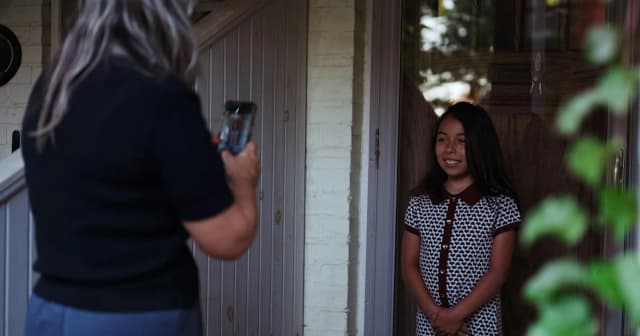
For the video, film in the same spot with the camera at the same height each year, say the date and age out loud, and then read the questions in order. One parent on Reddit described a similar habit, starting each birthday video by stating the date with the year and then asking the same questions, with the recordings kept private. Two minutes is a suggested cap for the youngest years; if an older child wants to keep talking, let the camera run.
Leave a few things out. Don't correct answers, suggest better ones, or let a sibling answer for the birthday kid. Keep presents and guests out of the room so the answers aren't aimed at an audience. Keep the videos in private storage your family controls instead of posting them.
Same spot and same framing every year is also the idea behind a first-day-of-school photo series, and the setup carries over almost unchanged.
Where year 3 lives so year 10 can find it
Choose one physical home for the cards and one folder for the videos before the first interview, and use the same naming rule every year.
| Method | What it captures | Where it lives | How to find year 3 in year 10 |
|---|---|---|---|
| Index card | Exact words, a drawing or signature | One box, cards in age order | Pull the first card in the stack |
| Two-minute video | Voice and face | One folder, plus backups | The file name starts with the age, so age 3 sorts first |
| Scan or photo of the card | A copy of the card | The same folder as the videos | Same name as that year's video, with "card" added |
| Audio only | Voice, for camera-shy years | The same folder | Same naming rule as the videos |
As of November 2026, the National Archives' guidance on digitizing family papers recommends file names in Latin letters without spaces, punctuation, or symbols, with hyphens or underscores in place of spaces. It also suggests adding basic "Who, What, Where, and When" information so files can be found and identified later. A name like birthday-interview_age-03_2029 sorts by age and still shows the year. In a list sorted by name, the two-digit age keeps age 10 from landing ahead of age 3.
The same guidance says to keep originals after you digitize them, because digital files can easily be lost, and to back up with a 3-2-1 rule: three copies, on two different media, with one copy off-site. For a birthday interview, that could be the folder on a computer, a copy on an external drive, and a copy in cloud storage or at a relative's home. Scan the card into the folder, then put the paper back in the box.
If you also write your child a yearly letter, the cards and letters can share one box, and the same storage choices apply to both.

What if your kid won't answer?
Write down what happened and ask again next year. A year of "pass," one-word answers, or jokes is still that year's answer. Skipping a year leaves a gap, but you can resume the next year.
If a child refuses, ask once more later the same day, in the same words, and then let it go. Rewording a question to coax an answer changes the thing you are comparing. Write "didn't want to answer" on the card with the date so the slot is filled.
One-word years happen at any age, so write the word down. Joke answers go on the card exactly as said. "A dinosaur" in answer to "What do you want to be when you grow up?" is a real answer from that birthday — and it may be the card people ask to see again.
Older kids sometimes want more control over the recording. Let a teenager hold the phone, write the answers in their own handwriting, or record audio only with the camera off. Keep cake and presents separate from the interview so it never feels like the price of the party.
Before the next birthday in your house, write the ten questions on one card and put it in the box where the answers will live.
Frequently asked questions
What questions would you ask your two-year-old self?
What questions should I ask my child on their birthday every year?
At what age should you start a birthday interview?
Should you post birthday interview videos online?
Sources
All sources checked on November 2, 2026.
- Emory Report, "Family meals important to children's emotional health" (Emory University, October 31, 2005) https://news.emory.edu/emory-report-archive/erarchive/2005/October/October%2031/S%26Rfamily.htm
- Fivush, Duke, and Bohanek, "Do You Know… The power of family history in adolescent identity and well-being" (research report PDF, February 23, 2010) https://ncph.org/wp-content/uploads/2013/12/The-power-of-family-history-in-adolescent-identity.pdf#page=1
- Press release on the review of family routines and rituals research (American Psychological Association, December 8, 2002) https://www.apa.org/news/press/releases/2002/12/rituals
- "Digitizing Family Papers and Photographs" (National Archives, May 26, 2021) https://www.archives.gov/preservation/family-archives/digitizing
- "Birthday interviews" thread, r/daddit (Reddit, undated) https://www.reddit.com/r/daddit/comments/pdok9h/birthday_interviews/


